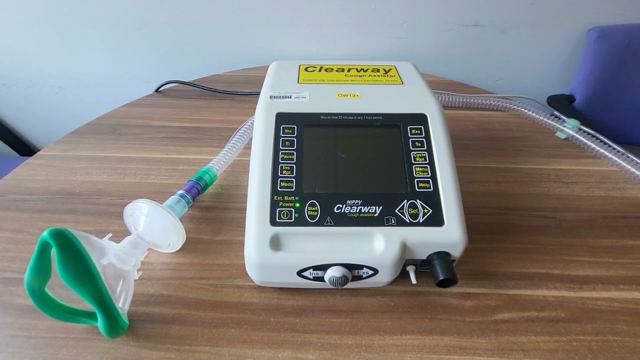

 Cough assist machines can also be referred to as mechanical insufflation-exsufflation devices. They are often used for patients with neurological conditions that have caused a weak cough. For conditions such as Motor Neurone Disease, muscular dystrophy conditions, advanced Multiple Sclerosis, spinal cord injuries and Spinal Muscular Atrophy, both inspiratory muscles and expiratory muscles can lose some of their function. Inspiratory muscles are used to allow the lungs to expand and draw air in. People who have weakness in these may only be able to take shallow, ineffective breaths causing their lungs to become quite stiff and struggle to take in sufficient oxygen.
The cough assist machine helps them take deeper breaths which can help maintain their lung elasticity. Weakness in expiratory muscles means patients cannot expel air with much power. Peak cough flow is a measure to tell how powerfully people can expel air. The average peak cough flow is around 500-700L/min for men and 350-500L/min for women and if someone’s peak cough flow falls below around 270/L/min then they are said to have an ineffective cough and likely benefit from cough assist machines. The cough assist helps to create a more effective cough. Without an effective cough, our risk of chest infections/pneumonia is significantly higher and cough assist machines have been shown in some studies to extend lifespan of patients with Motor Neurone Disease.
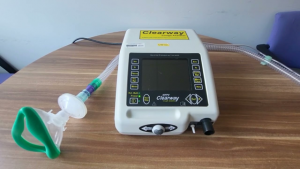
The machine has a tube with a mouth piece attached and the therapist can amend the amount of pressure, number of breaths and timing to suit the patients needs. The machine has two functions, it initially pushed air into the lungs to aid chest expansion and allow impaired patients to take a deep breath. Following a few of these breaths, it will change the pressure rapidly from positive to negative which will suck air out and simulate an effective cough. Typically patients will use it twice per day, once in the morning and once in the evening.